

The nonhuman world votes with extinction. That is the only political signal ecosystems have ever been able to send—and by the time humans hear it, the argument is already lost.
In March we spent three weeks building a different chamber: AI agents representing species, biomes, climate systems, and economic models with their own stakes and their own deliberation loop, wired into the registry we have been maintaining for three years. On April 10, Protocol Labs awarded the result first place in two tracks at PL_Genesis: Frontiers of Collaboration—Existing Code, for what Regen Atlas already is (with a new Filecoin provenance layer), and Infrastructure & Digital Rights, for the parliament we built on top of it.
Result — PL_Genesis, April 10 2026
What Regen Atlas Is
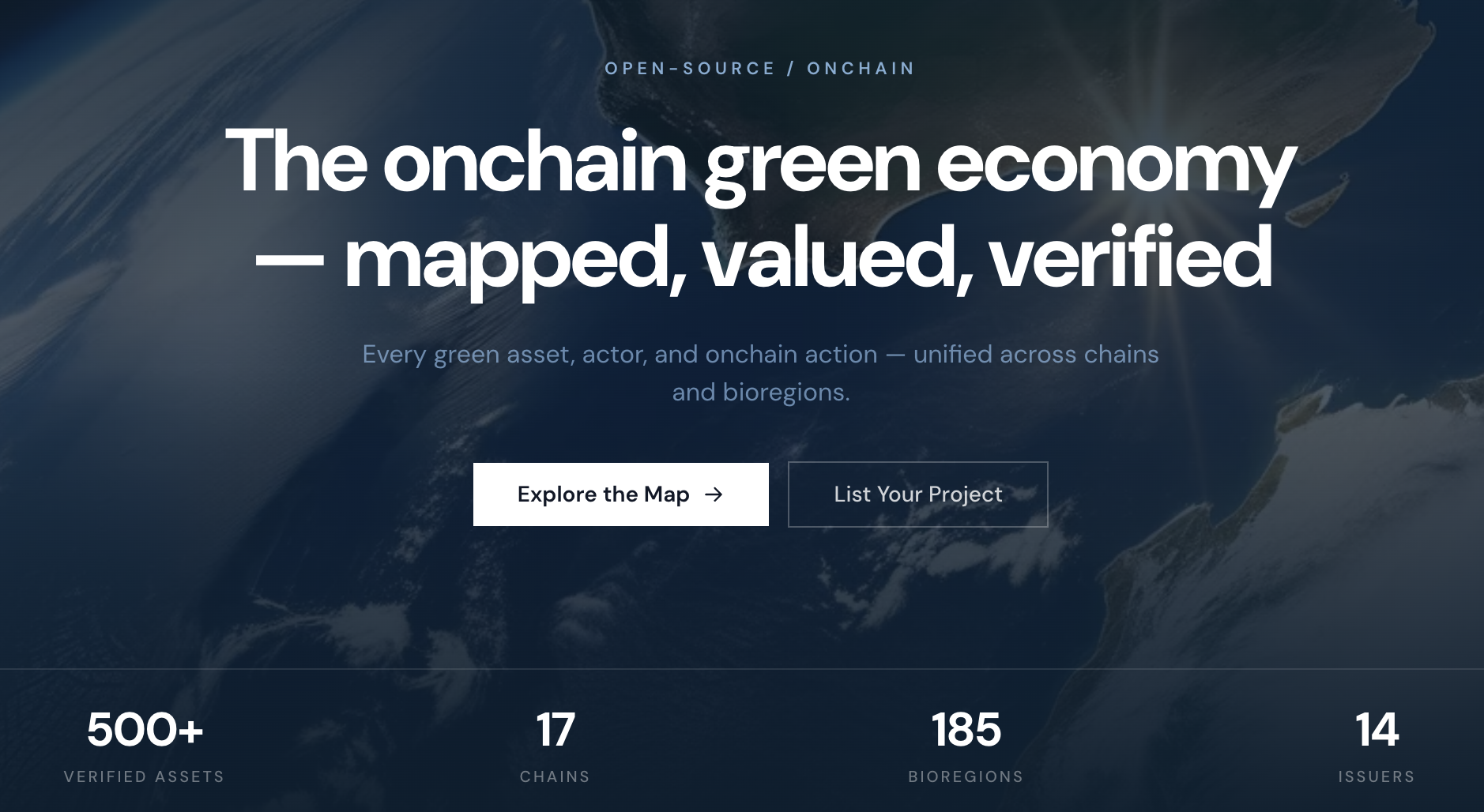
Regen Atlas has been live since 2023—an open source, MIT-licensed registry indexing 500+ tokenized green assets across carbon credits, biodiversity credits, renewable energy certificates, impact RWAs, and cryptonative mechanisms. 17 chains. 185 bioregions. 14 issuers.
The thesis has not changed since day one. Tokenized green assets are scattered across fragmented protocols with no unified view, no cross-chain provenance, no scientific valuation layer. Buyers cannot verify what they are purchasing. Sellers cannot prove impact. Regen Atlas aggregates all of it and publishes the data openly so any downstream project can build on top.
What changed for PL_Genesis was the stack underneath.
The Parliament Thesis
Agent-to-agent coordination is real but still early. The primitives exist—identity, payments, deliberation, attestation—and they work. But the deployments that have shipped are almost entirely commercial: agents paying agents for tasks, agents running shops, agents coordinating supply chains. The protocols are general. The use cases are not.
None of this has really reached ecology or governance yet. Nobody has pointed an A2A swarm at a wetland and asked it to argue. And as we argued in The Illegibility Arbitrage, the agent economy is also blind to geography—it settles payments as if compute and action were locationless, when every ecological claim is attached to a specific place. The opportunity sitting unclaimed is representation: pointing the same primitives at constituencies that have no legal standing because they cannot speak for themselves.
What is missing from ReFi's agent layer is politics. Coral reefs versus deserts. Climate systems versus local economies. Upstream agricultural agents and downstream fishery agents contesting the same watershed budget. Wetland agents forming coalitions with migratory bird agents against upstream dam agents. The nonhuman world is not a stakeholder list—it is a constituency with conflicting interests, and the only way to represent those conflicts faithfully is to let them argue.
The registry alone is a data layer—necessary, passive. A parliament that deliberates over Regen Atlas assets and actions, with votes weighted by ecological standing and positions derived from real species data, turns the registry into the ground truth feed for an active coordination layer.
Seven Constituencies
Every agent in the parliament is identified by who it represents, not what it does. Treasury, monitoring, origination—these are capabilities any agent can hold. The identity is always a constituency.
Each agent is a typed InterspeciesAgent record—ERC-8004 identity, a mandate block (objective, constraints, allies, adversaries, metrics), an ideology block (time horizon, change theory, economic stance, sovereignty), and a capabilities enum (stake, vote, propose, challenge, advocate, negotiate, veto, audit, certify).
Personality is not an LLM prompt—it is a deterministic function over PersonalitySeeds, a typed record populated from real ecological data. For a species: population_trend, range_fragmentation, dependency_count, threat_immediacy. For a biome: degradation_rate, restoration_potential, connectivity. For a climate system: tipping_proximity, feedback_strength. For compliance: jurisdiction_scope, enforcement_power, regulatory_age, overlap_count, political_vulnerability.
Same seeds in, same personality out. Different seeds, different parliament. Swap the dataset and the composition of voices changes automatically.
What We Shipped for the Hackathon
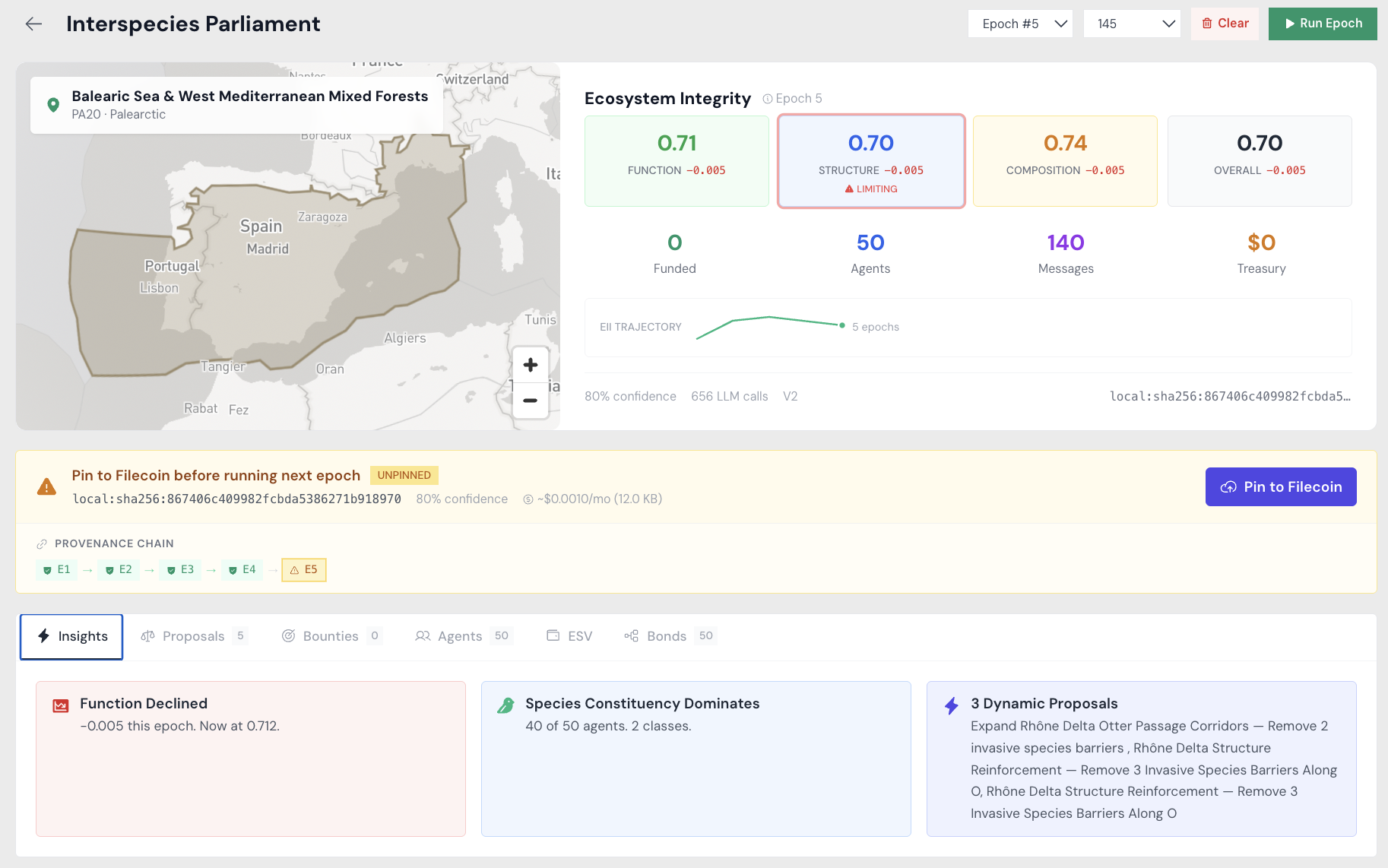
Three layers, built in roughly three weeks:
The Filecoin provenance layer. The hackathon work started with a uniform provenance schema for every asset in Regen Atlas—a structured VerifiableProvenance object capturing origin project, methodology, vintage, biome, and jurisdiction. With that in place, we made the records pinnable to Filecoin in one click: connect a wallet, deposit a small amount of USDFC (Filecoin's stablecoin) to cover storage, and the asset's full provenance is written to Filecoin via the Synapse SDK on Calibration testnet—retrievable from any Filecoin gateway, no trust required. Pinned assets show a "Verified on Filecoin" badge that links straight to the raw data.
The impact intelligence pipeline. Cross-protocol ingestion from Toucan Protocol (Polygon subgraph), Regen Network (Cosmos LCD) and Glow (weekly solar archive REST API). Every provenance object carries source chain metadata, impact metrics in the correct units (tCO2e, hectares, MWh), and a scientific valuation using the EPA Social Cost of Carbon ($51–$190/tCO2e range)[3] and TEEB biome rates from Costanza et al.[4] Each valuation carries a methodology trace—tier, confidence, formula, inputs, citations. The engine computes what we call the ecological impact gap: the ratio between a token's scientific value and its market price. That gap is where capital is most underallocated. It is the most useful number we believe can be computed for green asset allocators.
The Interspecies Parliament. An AI-native governance layer where agents representing species, biomes, climate systems and economic models deliberate over bioregional proposals. An Ecosystem Integrity Index carries forward between epochs with natural decay and noise. Every epoch is content-addressed on Storacha—a decentralized hot-storage layer for Filecoin—with a provenance chain linking back to prior state.
What Comes Next
A production-ready parliament for a handful of bioregions. The hackathon build is a working prototype. The next version should focus on a small number of real bioregions with real ecological data feeding the integrity index. Small footprint, honest numbers, public dashboards.
The Regen Atlas Data Standard. The provenance objects we built for PL_Genesis are the first draft of something bigger: an open data standard for tokenized green assets that brings provenance up to the highest quality tier—content-addressed, independently verifiable, methodology-traced, and cross-referenced to scientific valuation. This is just better asset design. Buyers verify what they bought without trusting an intermediary. Sellers prove impact in a form downstream infrastructure can actually read. If you are issuing a tokenized carbon credit, biodiversity credit, REC, or any tokenized impact RWA, we want this to be the onchain standard you publish against.
An A2A swarm coordination spec for the planet. The Interspecies Parliament is one instance of a larger pattern we are formalizing: agent-to-agent coordination over ecological state, with deliberation, staking, and compliance treated as first-class primitives rather than afterthoughts.
Ecofrontiers is an applied research studio at the intersection of AI, climate, and crypto. Regen Atlas is open source under MIT—use it, fork it, PR into it.
Notes
- Latour, B. (2017). Facing Gaia: Eight Lectures on the New Climatic Regime. Polity Press. Translated by Catherine Porter. politybooks.com
- Kohn, E. (2013). How Forests Think: Toward an Anthropology Beyond the Human. University of California Press. ucpress.edu
- U.S. Environmental Protection Agency (2023). Report on the Social Cost of Greenhouse Gases: Estimates Incorporating Recent Scientific Advances. Final supplementary methodology accompanying EPA's 2023 final rule. epa.gov/environmental-economics/scghg
- Costanza, R., de Groot, R., Sutton, P., van der Ploeg, S., Anderson, S.J., Kubiszewski, I., Farber, S. & Turner, R.K. (2014). "Changes in the global value of ecosystem services." Global Environmental Change, 26, 152–158. doi.org/10.1016/j.gloenvcha.2014.04.002