

Public-good funding (PGF) is about supporting something that is open, free, and inherently non-excludable — what markets alone cannot fund, but that is still crucial for collective benefit. In decentralized digital ecosystems, public goods are not merely important: as Vitalik notes, "in fact, there's a strong case that the average good that someone might want to produce is a public good".
What makes Web3 PGF fascinating is its evolutionary trajectory. Over the past few years, the field has cycled through numerous phases of experimentation. Each year brings claims of a "new era," and yet many patterns repeat. Observing these cycles — from Gitcoin Grants to Octant Epochs, to experimental deep funding models — offers a unique lens into how decentralized communities attempt to solve what are known as multi-polar traps: situations where coordination failures prevent optimal public-good provisioning. PGF is, in many ways, an attempt at multi-polar trap resistance.
This post synthesizes discussions, observations, and concerns gathered at Devconnect Buenos Aires, aiming to provide a snapshot of the current state of PGF.
Architects Everywhere...
Ethereum's openness fosters pluralism in funding mechanisms, allowing multiple protocols to coexist and experiment. Today, there is a veritable polyculture of PGF protocols or programs:
- Octant
- Protocol Guild
- Optimism
- Public Nouns
- Celo
- Giveth
- Gardens
- Gitcoin (recently shut down its quadratic funding platform, signaling desire to move towards more pluralism)
This diversity is generally seen as positive: decentralized systems benefit from having multiple options where public goods can be supported.
Alongside this polyculture of protocols exists a polyculture of allocation mechanisms:
- Quadratic funding (QF) remains the flagship approach, though recent data suggests shifts in donor behavior — smaller contributions concentrated on fewer projects, producing highly peaked preference distributions.
- Conviction voting and retroactive funding explore temporal and behavioral nuances.
- AI-driven funding, including simiocracy-style evaluators, introduces algorithmic curation.
- Impact staking pools, like those used by UNICEF, integrate performance incentives.
- Emerging deep funding experiments.
The lesson: we have highly sophisticated allocation engineering. The toolbox is vast, capable, and inventive.
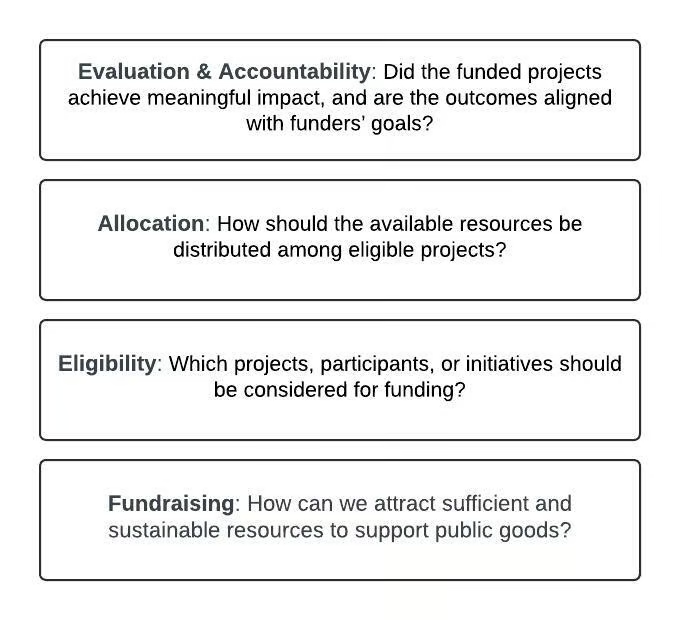
... But lack of foundations to stand on
Yet this architectural exuberance obscures a critical imbalance: we have far more innovation in allocation than in eligibility, fundraising, or evaluation.
1. Eligibility Mechanisms Are Underdeveloped
Sophisticated ways to distribute funding abound, yet the question of who should be eligible in the first place remains under-engineered. As Devansh Mehta emphasized during his talk at Schelling Point, we still rely on centralized, human-curated screening to decide which dependencies matter. The field lacks decentralized, automated, or empirically grounded ways to map critical software infrastructure.
Vitalik has captured the broader concern succinctly: "There is a general perception that public goods funding lacks rigor and is run on social desirability bias — what sounds good, rather than what is good — and favors insiders who can play the social game."
2. Fundraising Is Even Further Behind
Most funding still comes from a small number of large ecosystem actors voluntarily contributing. Alternatives exist but remain marginal:
- Block rewards (e.g., Filecoin)
- Embedding a Harberger tax into software licensing, proposed by Vitalik
- Enshrined thermorealism, a concept proposed by Patrick Rawson, which can be understood as a design principle that embeds verifiable energy and material accounting directly into core protocol operations.
But none of these have reached broad adoption. Fundraising remains one of the least innovated layers of the PGF stack.
3. Evaluation and Accountability Are Missing Links
Even the most sophisticated allocation mechanisms are ineffective in the absence of rigorous evaluation. As David Dao has observed, many public-goods funding experiments proceed by "running a fancy mechanism" without explicitly testing underlying hypotheses. Robust experimental design requires a structured workflow: formulate assumptions and hypotheses → implement the mechanism → evaluate outcomes. Absent this rigor, neither funders nor recipients can reliably determine what approaches are effective.
Evaluation and accountability are intrinsically linked. Without accurate measurement and oversight, projects may continue receiving resources irrespective of actual impact. For instance, Deep Funding initiatives faced significant challenges in collecting high-quality data, producing statistically unreliable results and raising ethical questions regarding which judgments the system ultimately amplifies. Concurrently, numerous funded projects have under-delivered, while the field lacks mechanisms to phase out underperforming initiatives. Funders require systems that provide clear, measurable returns on their contributions.
This gap has broader implications for ecosystem health. As Owocki notes, public-goods funding within Ethereum is losing mindshare. In buoyant market conditions, mediocrity is often obscured; as attention shifts, the absence of robust evaluation and accountability makes it increasingly difficult to distinguish genuinely impactful projects from well-intentioned but ineffective efforts.
To Conclude
Public-goods funding remains one of the most important — and intellectually rich — frontiers of Web3. The ecosystem boasts extraordinary architects, but it is time to redirect that talent. Instead of ever more allocation mechanisms, PGF needs ambitious innovation in fundraising, eligibility, evaluation, and accountability.
Until these foundations are strengthened, we will continue building tools faster than the workshop necessary to use them effectively.
Ecofrontiers is a research and advocacy program to provide theoretical and technical knowledge for better accounting and representation of natural capital with crypto. The team offers curious, new, and established Web3 projects consulting and advisory services.